3:I[39275,[],""]
5:I[61343,[],""]
6:I[23053,["7699","static/chunks/8e1d74a4-5fcc24cf3a9fd8c2.js","7240","static/chunks/53c13509-baa86b522e6ae78c.js","4740","static/chunks/4740-14bdf05e7ce04a11.js","9617","static/chunks/9617-544346a1cd0024b4.js","3185","static/chunks/app/layout-8c4bc5784f5090d9.js"],"StateProvider"]
7:I[19593,["7699","static/chunks/8e1d74a4-5fcc24cf3a9fd8c2.js","7240","static/chunks/53c13509-baa86b522e6ae78c.js","4740","static/chunks/4740-14bdf05e7ce04a11.js","9617","static/chunks/9617-544346a1cd0024b4.js","3185","static/chunks/app/layout-8c4bc5784f5090d9.js"],""]
8:I[18709,["7699","static/chunks/8e1d74a4-5fcc24cf3a9fd8c2.js","5706","static/chunks/9c4e2130-08078aeb5700c43b.js","5505","static/chunks/385cb88d-fd2f37c33b8aa92c.js","5452","static/chunks/5e22fd23-9bf9fa71e7554411.js","9956","static/chunks/ee560e2c-f551c028fd538293.js","4740","static/chunks/4740-14bdf05e7ce04a11.js","6648","static/chunks/6648-3bc9d66179346fb0.js","9160","static/chunks/app/not-found-5850ce7843ba4d5a.js"],"default"]
9:I[45723,["7699","static/chunks/8e1d74a4-5fcc24cf3a9fd8c2.js","7240","static/chunks/53c13509-baa86b522e6ae78c.js","4740","static/chunks/4740-14bdf05e7ce04a11.js","9617","static/chunks/9617-544346a1cd0024b4.js","3185","static/chunks/app/layout-8c4bc5784f5090d9.js"],"default"]
4:["all","overview-weblogic-application-server","c"]
0:["79z6y6ppLce0GndJRjYzJ",[[["",{"children":[["all","overview-weblogic-application-server","c"],{"children":["__PAGE__",{}]}]},"$undefined","$undefined",true],["",{"children":[["all","overview-weblogic-application-server","c"],{"children":["__PAGE__",{},[["$L1","$L2"],null],null]},["$","$L3",null,{"parallelRouterKey":"children","segmentPath":["children","$4","children"],"error":"$undefined","errorStyles":"$undefined","errorScripts":"$undefined","template":["$","$L5",null,{}],"templateStyles":"$undefined","templateScripts":"$undefined","notFound":"$undefined","notFoundStyles":"$undefined","styles":[["$","link","0",{"rel":"stylesheet","href":"/_next/static/css/402d889fee29bde2.css","precedence":"next","crossOrigin":"$undefined"}],["$","link","1",{"rel":"stylesheet","href":"/_next/static/css/0ff6cecb1d0e96f8.css","precedence":"next","crossOrigin":"$undefined"}],["$","link","2",{"rel":"stylesheet","href":"/_next/static/css/cb4e98a4c2dc4d80.css","precedence":"next","crossOrigin":"$undefined"}],["$","link","3",{"rel":"stylesheet","href":"/_next/static/css/a246b44e33111fd9.css","precedence":"next","crossOrigin":"$undefined"}],["$","link","4",{"rel":"stylesheet","href":"/_next/static/css/9d9d0f6a85930e46.css","precedence":"next","crossOrigin":"$undefined"}]]}],null]},[["$","html",null,{"lang":"en","children":["$","body",null,{"children":["$","$L6",null,{"children":[["$","$L7",null,{}],["$","$L3",null,{"parallelRouterKey":"children","segmentPath":["children"],"error":"$undefined","errorStyles":"$undefined","errorScripts":"$undefined","template":["$","$L5",null,{}],"templateStyles":"$undefined","templateScripts":"$undefined","notFound":["$","$L8",null,{}],"notFoundStyles":[["$","link","0",{"rel":"stylesheet","href":"/_next/static/css/cb4e98a4c2dc4d80.css","precedence":"next","crossOrigin":"$undefined"}]],"styles":null}],["$","$L9",null,{}]]}]}]}],null],null],[[["$","link","0",{"rel":"stylesheet","href":"/_next/static/css/0cc2495744a38244.css","precedence":"next","crossOrigin":"$undefined"}]],"$La"]]]]
b:I[67379,["7699","static/chunks/8e1d74a4-5fcc24cf3a9fd8c2.js","5706","static/chunks/9c4e2130-08078aeb5700c43b.js","5505","static/chunks/385cb88d-fd2f37c33b8aa92c.js","5452","static/chunks/5e22fd23-9bf9fa71e7554411.js","9956","static/chunks/ee560e2c-f551c028fd538293.js","7240","static/chunks/53c13509-baa86b522e6ae78c.js","6051","static/chunks/795d4814-d7614a20709c27af.js","614","static/chunks/3d47b92a-f2bb54912083012c.js","9212","static/chunks/59650de3-13cfd2620b7240d2.js","522","static/chunks/94730671-a8ad9eca65504500.js","7675","static/chunks/b563f954-501d993050fd0717.js","1994","static/chunks/e34aaff9-cd556a7ee1a90c03.js","6990","static/chunks/13b76428-5a68792917164904.js","5957","static/chunks/30a37ab2-a5fc2d8864b3152b.js","6844","static/chunks/f25cdb8d-30c837856fb6d42d.js","7259","static/chunks/479ba886-8536ff4966e1aaf8.js","4740","static/chunks/4740-14bdf05e7ce04a11.js","6648","static/chunks/6648-3bc9d66179346fb0.js","4349","static/chunks/4349-c8f0646a83cc4179.js","4791","static/chunks/4791-6c93b9aca8a9f315.js","5225","static/chunks/5225-dc21c87d99338f19.js","9293","static/chunks/9293-d1b040d0324d0d5a.js","5919","static/chunks/5919-545104f05818203e.js","1413","static/chunks/1413-986ad1f4cd2d661e.js","2499","static/chunks/2499-61bd3b514e9c4cb8.js","4175","static/chunks/4175-fb05509a4e1790ec.js","5653","static/chunks/app/%5B...all%5D/page-f1bbbeae9a681a62.js"],"default"]
c:T3a4e,<p style="text-align: justify;"><span style="color: #e03e2d;"><strong>WebLogic Server</strong></span> is based on Java 2 Platform, Enterprise Edition (J2EE), the standard platform used to create Java-based multi-tier enterprise applications. J2EE platform technologies were developed through the efforts of BEA Systems and other vendors in collaboration with the main developer, Sun Microsystems.&nbsp;It manages system-level details so you can concentrate on business logic and presentation.</p>
<p style="text-align: justify;">The following are the various Weblogic Server&nbsp;versions released from 2002. The most recent version of Weblogic is 12c.</p>
<h2 style="text-align: justify;"><span style="color: #e03e2d; font-size: 14pt;">Weblogic Server Versions</span></h2>
<p style="text-align: justify;">WebLogic Server 12c Release 3 (12.1.3) - June 26, 2014</p>
<p style="text-align: justify;">WebLogic Server 12c Release 2 (12.1.2) - July 11, 2013</p>
<p style="text-align: justify;">WebLogic Server 12c Release 1 (12.1.1) - Dec 1, 2011</p>
<p style="text-align: justify;">WebLogic Server 11gR1 PS5 (10.3.6) - February 26, 2012</p>
<p style="text-align: justify;">WebLogic Server 11gR1 PS4 (10.3.5) - May 16, 2011</p>
<p style="text-align: justify;">WebLogic Server 11gR1 PS3 (10.3.4) - January 15, 2011</p>
<p style="text-align: justify;">WebLogic Server 11gR1 PS2 (10.3.3) - April 2010</p>
<p style="text-align: justify;">WebLogic Server 11gR1 PS1 (10.3.2) - Nov 2009</p>
<p style="text-align: justify;">WebLogic Server 11g (10.3.1) - Jul 2009</p>
<p style="text-align: justify;">WebLogic Server 10.3 - Aug 2008</p>
<p style="text-align: justify;">WebLogic Server 10.0 - Mar 2007</p>
<p style="text-align: justify;">WebLogic Server 9.2</p>
<p style="text-align: justify;">WebLogic Server 9.1</p>
<p style="text-align: justify;">WebLogic Server 9.0 - Nov 2006</p>
<p style="text-align: justify;">WebLogic Server 8.1 - Jul 2003</p>
<p style="text-align: justify;">WebLogic Server 7.0 - Jun 2002</p>
<p style="padding-left: 30px; text-align: center;">[button url="http://tekslate.com/weblogic-server-administration-training/" class="other" bg="" hover_bg="" size="0px" color="#f7f7f7" radius="0px" width="0px" height="0px" target="_self"] Oracle Weblogic Training [/button]</p>
<h2 style="text-align: justify;"><span style="color: #e03e2d; font-size: 14pt;">Weblogic Server Core Components</span></h2>
<p style="text-align: justify;">Oracle WebLogic Server supports Oracle, DB2, MS SQL Server, MySQL Enterprise and other JDBC-compliant databases. Oracle Weblogic Platform also includes:</p>
<ul style="text-align: justify;">
<li>Core Components like Enterprise Grid Messaging, JMS Messaging Standard, JRockit, Oracle Top Link, Oracle WebLogic Server Web Services, Tuxedo</li>
</ul>
<ul style="text-align: justify;">
<li>Supported open standards like <a href="https://tekslate.com/administering-bpel-process-service-components-engines/" target="_blank" rel="noopener">BPEL</a> &amp; BPEL-J, ebXML, JAAS, Java EE 1.3 &amp; 1.4 &amp; 5, JPA 1.0 (2.0 available), JMX and SNMP</li>
</ul>
<ul style="text-align: justify;">
<li>Native support for: SOAP, UDDI, WSDL, WSRP, WS-Security, XSLT and XQuery</li>
</ul>
<h3 style="text-align: justify;"><span style="font-size: 12pt; color: #e03e2d;"><strong>Standards support by version</strong></span></h3>
<p style="text-align: justify;">The table below lists major standards supported by the WebLogic Server product version.</p>
<table>
<tbody>
<tr>
<td>Standard</td>
<td>WLS 7.0</td>
<td>WLS 8.1</td>
<td>WLS 9.0</td>
<td>WLS 10.0</td>
<td>WLS 10.3</td>
</tr>
<tr>
<td>Java</td>
<td>1.3</td>
<td>1.4</td>
<td>5</td>
<td>5</td>
<td>6</td>
</tr>
<tr>
<td>Java EE</td>
<td>1.3</td>
<td>1.3</td>
<td>1.4</td>
<td>5</td>
<td>5</td>
</tr>
</tbody>
</table>
<h2 style="text-align: justify;"><span style="color: #e03e2d; font-size: 14pt;">Overview of WebLogic Server System Administration</span></h2>
<p style="text-align: justify;">System administration of WebLogic Server includes a wide range of tasks: creating WebLogic Server domains; deploying applications; migrating domains from development environments to production environments; monitoring and managing the performance of the run-time system, and diagnosing and troubleshooting problems. (A WebLogic Server <strong>domain</strong> is a collection of WebLogic Server services designed for a specific purpose. For example, you might create one domain to provide an employee portal and another domain to provide business services to your customers.)</p>
<p style="text-align: justify;">Because the WebLogic Server management system is based on Java EE and other standards, it integrates with systems that are frequently used to manage other software and hardware components. Also, WebLogic Server includes several of its own standards-based, extensible utilities. Alternatively, you can use APIs to create custom management utilities.</p>
<p style="text-align: justify;">At the end of this module you will be able to:</p>
<ul style="text-align: justify;">
<li>What are Software Component Tiers</li>
<li>The Web &amp; Application Server and Differences</li>
<li>J2EE Platform and WebLogic Server</li>
<li>Weblogic Server Versions &amp; Capabilities</li>
</ul>
<h2 style="text-align: justify;"><span style="color: #e03e2d; font-size: 14pt;">Software Component Tiers</span></h2>
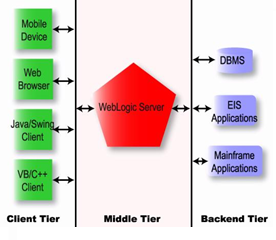
<p style="text-align: justify;">The software components of a multitier architecture consist of three tiers:</p>
<ul style="text-align: justify;">
<li>The client tier contains programs executed by users, including Web browsers and network-capable application programs. These programs can be written in virtually any programming language.</li>
</ul>
<ul style="text-align: justify;">
<li>The middle tier contains <a href="https://tekslate.com/configuring-weblogic-server-environment/" target="_blank" rel="noopener">WebLogic Server</a> and other servers that are addressed directly by clients, such as existing Web servers or proxy servers.</li>
</ul>
<ul style="text-align: justify;">
<li>The backend tier contains enterprise resources, such as database systems, mainframe and legacy applications, and packaged enterprise resource planning (ERP) applications.</li>
</ul>
<p style="text-align: justify;"><img class="aligncenter wp-image-2254" title="Weblogic Server Component Tiers" src="https://newtekslateassets.s3.us-west-2.amazonaws.com/wp-content/uploads/2014/11/126.png" alt="Weblogic Server Component Tiers" width="352" height="306" /></p>
<p style="text-align: center;">[button url="http://tekslate.com/tutorials/weblogic-tutorials-how-to/" class="other" bg="" hover_bg="" size="0px" color="#f7f7f7" radius="0px" width="0px" height="0px" target="_self"] Oracle Weblogic Tutorials [/button]</p>
<h2 style="text-align: justify;"><span style="color: #e03e2d; font-size: 14pt;">The Web Server</span></h2>
<p style="text-align: justify;">A Web server handles the HTTP protocol. When the Web server receives an HTTP request, it responds with an HTTP response, such as sending back an <a href="https://tekslate.com/tutorials/html-tutorials/" target="_blank" rel="noopener">HTML</a> page. To process a request, a Web server may respond with a static HTML page or image, send a redirect, or delegate the dynamic response generation to some other program such as CGI scripts, JSPs (JavaServer Pages), servlets, ASPs (Active Server Pages), server-side JavaScripts, or some other server-side technology. Whatever their purpose, such server-side programs generate a response, most often in HTML, for viewing in a Web browser.</p>
<p style="text-align: justify;">Understand that a Web server's delegation model is fairly simple. When a request comes into the Web server, the Web server simply passes the request to the program best able to handle it. The Web server doesn't provide any functionality beyond simply providing an environment in which the server-side program can execute and pass back the generated responses. The server-side program usually provides for itself such functions as transaction processing, database connectivity, and messaging.</p>
<p style="text-align: justify;">While a Web server may not itself support transactions or database connection pooling, it may employ various strategies for fault tolerance and scalability such as load balancing, caching, and clustering&mdash;features often erroneously assigned as features reserved only for application servers.</p>
<ul style="text-align: justify;">
<li>Provides Web content</li>
<li>Communicate via HTTP, FTP, etc</li>
<li>Can handle CGI requests</li>
</ul>
<p style="text-align: justify;">Proxy some requests to Application Servers</p>
<p style="text-align: justify;"><img class="wp-image-2255 aligncenter" title="Weblogic Server" src="https://newtekslateassets.s3.us-west-2.amazonaws.com/wp-content/uploads/2014/11/217.png" alt="Weblogic Server" width="508" height="272" /></p>
<h2 style="text-align: justify;"><span style="color: #e03e2d; font-size: 14pt;">The Application Server</span></h2>
<p style="text-align: justify;"><strong>&nbsp;</strong>As for the application server, according to our definition, an application server exposes business logic to client applications through various protocols, possibly including HTTP. While a Web server mainly deals with sending HTML for display in a Web browser, an application server provides access to business logic for use by client application programs. The application program can use this logic just as it would call a method on an object (or a function in the procedural world).</p>
<p style="text-align: justify;">Such application server clients can include GUIs (graphical user interface) running on a PC, a Web server, or even other application servers. The information traveling back and forth between an application server and its client is not restricted to simple display markup. Instead, the information is program logic. Since the logic takes the form of data and method calls and not static HTML, the client can employ the exposed business logic however it wants.</p>
<p style="text-align: justify;">In most cases, the server exposes this business logic through a component API, such as the EJB (Enterprise JavaBean) component model found on J2EE (Java 2 Platform, Enterprise Edition) application servers. Moreover, the application server manages its own resources. Such gate-keeping duties include security, transaction processing, resource pooling, and messaging. As&nbsp;a Web server, an application server may also employ various scalability and fault-tolerance techniques.</p>
<p style="text-align: justify;"><img class="wp-image-2256 aligncenter" title="Weblogic Application Server" src="https://newtekslateassets.s3.us-west-2.amazonaws.com/wp-content/uploads/2014/11/317.png" alt="Weblogic Application Server" width="388" height="313" /></p>
<h4 style="text-align: justify;"><span style="font-size: 12pt; color: #e03e2d;"><strong>Application servers:</strong></span></h4>
<ul style="text-align: justify;">
<li>Provide services that support the execution and availability of deployed applications</li>
<li>Handle heavier processing chores than Web servers</li>
</ul>
<h3 style="text-align: justify;"><span style="color: #e03e2d; font-size: 12pt;"><strong>Differences Between Application Server vs. Web Server</strong></span></h3>
<h4 style="text-align: justify;"><span style="color: #e03e2d;"><strong>&nbsp;</strong><strong>What is it?</strong></span></h4>
<p style="text-align: justify; padding-left: 30px;">Application Server: A server that exposes business logic to client applications through various protocols including HTTP.</p>
<p style="text-align: justify; padding-left: 30px;">Web Server: A server that handles HTTP protocol.</p>
<h4 style="text-align: justify;"><span style="color: #e03e2d;"><strong>Functions:</strong></span></h4>
<p style="text-align: justify; padding-left: 30px;">Application Server: To deliver various applications to another device, it allows everyone in the network to run software off of the same machine.</p>
<p style="text-align: justify; padding-left: 30px;">Web Server: Keeping HTML, PHP, ASP, etc. files available for the web browsers to view when a user accesses the site on the web, handles HTTP requests from clients.</p>
<h4 style="text-align: justify;"><span style="color: #e03e2d;"><strong>Clients can include:</strong></span></h4>
<p style="text-align: justify; padding-left: 30px;">Application Server:&nbsp; GUI&rsquo;s, Web Servers</p>
<p style="text-align: justify; padding-left: 30px;">Web Server: &nbsp;HTTP, HTML</p>
<h4 style="text-align: justify;"><span style="color: #e03e2d;"><strong>Functionality:</strong></span></h4>
<p style="text-align: justify; padding-left: 30px;">Application Server:&nbsp; Adds functionality</p>
<p style="text-align: justify; padding-left: 30px;">Web Server: Does not add any</p>
<h4 style="text-align: justify;"><span style="color: #e03e2d;"><strong>Examples of popular server products:</strong></span></h4>
<p style="text-align: justify; padding-left: 30px;">Application Server:&nbsp; Oracle OC4J(Oracle), Sybase Application server(Sybase), SAP Netweaver (SAP), <a title="JBoss" href="jboss" target="_blank" rel="noopener"><span style="color: #000000;">Jboss</span></a> (Red Hat), WebLogic Server (Oracle), WebSphere (IBM)</p>
<p style="text-align: justify; padding-left: 30px;">Web Server: &nbsp;Microsoft IIS, Apache Tomcat</p>
<h2 style="text-align: justify;"><strong>&nbsp;</strong><span style="color: #e03e2d; font-size: 14pt;"><strong>J2EE Platform and WebLogic Server</strong></span></h2>
<p style="text-align: justify;"><strong>&nbsp;</strong>WebLogic Server J2EE applications are based on standardized, modular components. WebLogic Server provides a complete set of services for those modules and handles many details of application behavior automatically, without requiring programming.</p>
<p style="text-align: justify;">J2EE includes deployment specifications for Web applications, EJB modules, Enterprise applications, client applications, and connectors. J2EE does not specify <em>how</em> an application is deployed on the target server&mdash;only how a standard module or application is packaged.</p>
<p style="text-align: justify;">Java is platform independent, so you can edit and compile code on any platform, and test your applications on development WebLogic Servers running on other platforms. For example, it is common to develop WebLogic Server applications on a PC running Windows or Linux, regardless of the platform where the application is ultimately deployed.</p>
<h4 style="text-align: justify;"><span style="color: #e03e2d;"><strong>Summary:</strong><strong>&nbsp;</strong></span></h4>
<ul style="text-align: justify;">
<li>Covered Software Component Tiers</li>
<li>Covered Overview and Differences of Web Server and Application Server</li>
<li>Overview of J2EE Platform and WebLogic Server</li>
</ul>e:T3a4e,<p style="text-align: justify;"><span style="color: #e03e2d;"><strong>WebLogic Server</strong></span> is based on Java 2 Platform, Enterprise Edition (J2EE), the standard platform used to create Java-based multi-tier enterprise applications. J2EE platform technologies were developed through the efforts of BEA Systems and other vendors in collaboration with the main developer, Sun Microsystems.&nbsp;It manages system-level details so you can concentrate on business logic and presentation.</p>
<p style="text-align: justify;">The following are the various Weblogic Server&nbsp;versions released from 2002. The most recent version of Weblogic is 12c.</p>
<h2 style="text-align: justify;"><span style="color: #e03e2d; font-size: 14pt;">Weblogic Server Versions</span></h2>
<p style="text-align: justify;">WebLogic Server 12c Release 3 (12.1.3) - June 26, 2014</p>
<p style="text-align: justify;">WebLogic Server 12c Release 2 (12.1.2) - July 11, 2013</p>
<p style="text-align: justify;">WebLogic Server 12c Release 1 (12.1.1) - Dec 1, 2011</p>
<p style="text-align: justify;">WebLogic Server 11gR1 PS5 (10.3.6) - February 26, 2012</p>
<p style="text-align: justify;">WebLogic Server 11gR1 PS4 (10.3.5) - May 16, 2011</p>
<p style="text-align: justify;">WebLogic Server 11gR1 PS3 (10.3.4) - January 15, 2011</p>
<p style="text-align: justify;">WebLogic Server 11gR1 PS2 (10.3.3) - April 2010</p>
<p style="text-align: justify;">WebLogic Server 11gR1 PS1 (10.3.2) - Nov 2009</p>
<p style="text-align: justify;">WebLogic Server 11g (10.3.1) - Jul 2009</p>
<p style="text-align: justify;">WebLogic Server 10.3 - Aug 2008</p>
<p style="text-align: justify;">WebLogic Server 10.0 - Mar 2007</p>
<p style="text-align: justify;">WebLogic Server 9.2</p>
<p style="text-align: justify;">WebLogic Server 9.1</p>
<p style="text-align: justify;">WebLogic Server 9.0 - Nov 2006</p>
<p style="text-align: justify;">WebLogic Server 8.1 - Jul 2003</p>
<p style="text-align: justify;">WebLogic Server 7.0 - Jun 2002</p>
<p style="padding-left: 30px; text-align: center;">[button url="http://tekslate.com/weblogic-server-administration-training/" class="other" bg="" hover_bg="" size="0px" color="#f7f7f7" radius="0px" width="0px" height="0px" target="_self"] Oracle Weblogic Training [/button]</p>
<h2 style="text-align: justify;"><span style="color: #e03e2d; font-size: 14pt;">Weblogic Server Core Components</span></h2>
<p style="text-align: justify;">Oracle WebLogic Server supports Oracle, DB2, MS SQL Server, MySQL Enterprise and other JDBC-compliant databases. Oracle Weblogic Platform also includes:</p>
<ul style="text-align: justify;">
<li>Core Components like Enterprise Grid Messaging, JMS Messaging Standard, JRockit, Oracle Top Link, Oracle WebLogic Server Web Services, Tuxedo</li>
</ul>
<ul style="text-align: justify;">
<li>Supported open standards like <a href="https://tekslate.com/administering-bpel-process-service-components-engines/" target="_blank" rel="noopener">BPEL</a> &amp; BPEL-J, ebXML, JAAS, Java EE 1.3 &amp; 1.4 &amp; 5, JPA 1.0 (2.0 available), JMX and SNMP</li>
</ul>
<ul style="text-align: justify;">
<li>Native support for: SOAP, UDDI, WSDL, WSRP, WS-Security, XSLT and XQuery</li>
</ul>
<h3 style="text-align: justify;"><span style="font-size: 12pt; color: #e03e2d;"><strong>Standards support by version</strong></span></h3>
<p style="text-align: justify;">The table below lists major standards supported by the WebLogic Server product version.</p>
<table>
<tbody>
<tr>
<td>Standard</td>
<td>WLS 7.0</td>
<td>WLS 8.1</td>
<td>WLS 9.0</td>
<td>WLS 10.0</td>
<td>WLS 10.3</td>
</tr>
<tr>
<td>Java</td>
<td>1.3</td>
<td>1.4</td>
<td>5</td>
<td>5</td>
<td>6</td>
</tr>
<tr>
<td>Java EE</td>
<td>1.3</td>
<td>1.3</td>
<td>1.4</td>
<td>5</td>
<td>5</td>
</tr>
</tbody>
</table>
<h2 style="text-align: justify;"><span style="color: #e03e2d; font-size: 14pt;">Overview of WebLogic Server System Administration</span></h2>
<p style="text-align: justify;">System administration of WebLogic Server includes a wide range of tasks: creating WebLogic Server domains; deploying applications; migrating domains from development environments to production environments; monitoring and managing the performance of the run-time system, and diagnosing and troubleshooting problems. (A WebLogic Server <strong>domain</strong> is a collection of WebLogic Server services designed for a specific purpose. For example, you might create one domain to provide an employee portal and another domain to provide business services to your customers.)</p>
<p style="text-align: justify;">Because the WebLogic Server management system is based on Java EE and other standards, it integrates with systems that are frequently used to manage other software and hardware components. Also, WebLogic Server includes several of its own standards-based, extensible utilities. Alternatively, you can use APIs to create custom management utilities.</p>
<p style="text-align: justify;">At the end of this module you will be able to:</p>
<ul style="text-align: justify;">
<li>What are Software Component Tiers</li>
<li>The Web &amp; Application Server and Differences</li>
<li>J2EE Platform and WebLogic Server</li>
<li>Weblogic Server Versions &amp; Capabilities</li>
</ul>
<h2 style="text-align: justify;"><span style="color: #e03e2d; font-size: 14pt;">Software Component Tiers</span></h2>
<p style="text-align: justify;">The software components of a multitier architecture consist of three tiers:</p>
<ul style="text-align: justify;">
<li>The client tier contains programs executed by users, including Web browsers and network-capable application programs. These programs can be written in virtually any programming language.</li>
</ul>
<ul style="text-align: justify;">
<li>The middle tier contains <a href="https://tekslate.com/configuring-weblogic-server-environment/" target="_blank" rel="noopener">WebLogic Server</a> and other servers that are addressed directly by clients, such as existing Web servers or proxy servers.</li>
</ul>
<ul style="text-align: justify;">
<li>The backend tier contains enterprise resources, such as database systems, mainframe and legacy applications, and packaged enterprise resource planning (ERP) applications.</li>
</ul>
<p style="text-align: justify;"><img class="aligncenter wp-image-2254" title="Weblogic Server Component Tiers" src="https://newtekslateassets.s3.us-west-2.amazonaws.com/wp-content/uploads/2014/11/126.png" alt="Weblogic Server Component Tiers" width="352" height="306" /></p>
<p style="text-align: center;">[button url="http://tekslate.com/tutorials/weblogic-tutorials-how-to/" class="other" bg="" hover_bg="" size="0px" color="#f7f7f7" radius="0px" width="0px" height="0px" target="_self"] Oracle Weblogic Tutorials [/button]</p>
<h2 style="text-align: justify;"><span style="color: #e03e2d; font-size: 14pt;">The Web Server</span></h2>
<p style="text-align: justify;">A Web server handles the HTTP protocol. When the Web server receives an HTTP request, it responds with an HTTP response, such as sending back an <a href="https://tekslate.com/tutorials/html-tutorials/" target="_blank" rel="noopener">HTML</a> page. To process a request, a Web server may respond with a static HTML page or image, send a redirect, or delegate the dynamic response generation to some other program such as CGI scripts, JSPs (JavaServer Pages), servlets, ASPs (Active Server Pages), server-side JavaScripts, or some other server-side technology. Whatever their purpose, such server-side programs generate a response, most often in HTML, for viewing in a Web browser.</p>
<p style="text-align: justify;">Understand that a Web server's delegation model is fairly simple. When a request comes into the Web server, the Web server simply passes the request to the program best able to handle it. The Web server doesn't provide any functionality beyond simply providing an environment in which the server-side program can execute and pass back the generated responses. The server-side program usually provides for itself such functions as transaction processing, database connectivity, and messaging.</p>
<p style="text-align: justify;">While a Web server may not itself support transactions or database connection pooling, it may employ various strategies for fault tolerance and scalability such as load balancing, caching, and clustering&mdash;features often erroneously assigned as features reserved only for application servers.</p>
<ul style="text-align: justify;">
<li>Provides Web content</li>
<li>Communicate via HTTP, FTP, etc</li>
<li>Can handle CGI requests</li>
</ul>
<p style="text-align: justify;">Proxy some requests to Application Servers</p>
<p style="text-align: justify;"><img class="wp-image-2255 aligncenter" title="Weblogic Server" src="https://newtekslateassets.s3.us-west-2.amazonaws.com/wp-content/uploads/2014/11/217.png" alt="Weblogic Server" width="508" height="272" /></p>
<h2 style="text-align: justify;"><span style="color: #e03e2d; font-size: 14pt;">The Application Server</span></h2>
<p style="text-align: justify;"><strong>&nbsp;</strong>As for the application server, according to our definition, an application server exposes business logic to client applications through various protocols, possibly including HTTP. While a Web server mainly deals with sending HTML for display in a Web browser, an application server provides access to business logic for use by client application programs. The application program can use this logic just as it would call a method on an object (or a function in the procedural world).</p>
<p style="text-align: justify;">Such application server clients can include GUIs (graphical user interface) running on a PC, a Web server, or even other application servers. The information traveling back and forth between an application server and its client is not restricted to simple display markup. Instead, the information is program logic. Since the logic takes the form of data and method calls and not static HTML, the client can employ the exposed business logic however it wants.</p>
<p style="text-align: justify;">In most cases, the server exposes this business logic through a component API, such as the EJB (Enterprise JavaBean) component model found on J2EE (Java 2 Platform, Enterprise Edition) application servers. Moreover, the application server manages its own resources. Such gate-keeping duties include security, transaction processing, resource pooling, and messaging. As&nbsp;a Web server, an application server may also employ various scalability and fault-tolerance techniques.</p>
<p style="text-align: justify;"><img class="wp-image-2256 aligncenter" title="Weblogic Application Server" src="https://newtekslateassets.s3.us-west-2.amazonaws.com/wp-content/uploads/2014/11/317.png" alt="Weblogic Application Server" width="388" height="313" /></p>
<h4 style="text-align: justify;"><span style="font-size: 12pt; color: #e03e2d;"><strong>Application servers:</strong></span></h4>
<ul style="text-align: justify;">
<li>Provide services that support the execution and availability of deployed applications</li>
<li>Handle heavier processing chores than Web servers</li>
</ul>
<h3 style="text-align: justify;"><span style="color: #e03e2d; font-size: 12pt;"><strong>Differences Between Application Server vs. Web Server</strong></span></h3>
<h4 style="text-align: justify;"><span style="color: #e03e2d;"><strong>&nbsp;</strong><strong>What is it?</strong></span></h4>
<p style="text-align: justify; padding-left: 30px;">Application Server: A server that exposes business logic to client applications through various protocols including HTTP.</p>
<p style="text-align: justify; padding-left: 30px;">Web Server: A server that handles HTTP protocol.</p>
<h4 style="text-align: justify;"><span style="color: #e03e2d;"><strong>Functions:</strong></span></h4>
<p style="text-align: justify; padding-left: 30px;">Application Server: To deliver various applications to another device, it allows everyone in the network to run software off of the same machine.</p>
<p style="text-align: justify; padding-left: 30px;">Web Server: Keeping HTML, PHP, ASP, etc. files available for the web browsers to view when a user accesses the site on the web, handles HTTP requests from clients.</p>
<h4 style="text-align: justify;"><span style="color: #e03e2d;"><strong>Clients can include:</strong></span></h4>
<p style="text-align: justify; padding-left: 30px;">Application Server:&nbsp; GUI&rsquo;s, Web Servers</p>
<p style="text-align: justify; padding-left: 30px;">Web Server: &nbsp;HTTP, HTML</p>
<h4 style="text-align: justify;"><span style="color: #e03e2d;"><strong>Functionality:</strong></span></h4>
<p style="text-align: justify; padding-left: 30px;">Application Server:&nbsp; Adds functionality</p>
<p style="text-align: justify; padding-left: 30px;">Web Server: Does not add any</p>
<h4 style="text-align: justify;"><span style="color: #e03e2d;"><strong>Examples of popular server products:</strong></span></h4>
<p style="text-align: justify; padding-left: 30px;">Application Server:&nbsp; Oracle OC4J(Oracle), Sybase Application server(Sybase), SAP Netweaver (SAP), <a title="JBoss" href="jboss" target="_blank" rel="noopener"><span style="color: #000000;">Jboss</span></a> (Red Hat), WebLogic Server (Oracle), WebSphere (IBM)</p>
<p style="text-align: justify; padding-left: 30px;">Web Server: &nbsp;Microsoft IIS, Apache Tomcat</p>
<h2 style="text-align: justify;"><strong>&nbsp;</strong><span style="color: #e03e2d; font-size: 14pt;"><strong>J2EE Platform and WebLogic Server</strong></span></h2>
<p style="text-align: justify;"><strong>&nbsp;</strong>WebLogic Server J2EE applications are based on standardized, modular components. WebLogic Server provides a complete set of services for those modules and handles many details of application behavior automatically, without requiring programming.</p>
<p style="text-align: justify;">J2EE includes deployment specifications for Web applications, EJB modules, Enterprise applications, client applications, and connectors. J2EE does not specify <em>how</em> an application is deployed on the target server&mdash;only how a standard module or application is packaged.</p>
<p style="text-align: justify;">Java is platform independent, so you can edit and compile code on any platform, and test your applications on development WebLogic Servers running on other platforms. For example, it is common to develop WebLogic Server applications on a PC running Windows or Linux, regardless of the platform where the application is ultimately deployed.</p>
<h4 style="text-align: justify;"><span style="color: #e03e2d;"><strong>Summary:</strong><strong>&nbsp;</strong></span></h4>
<ul style="text-align: justify;">
<li>Covered Software Component Tiers</li>
<li>Covered Overview and Differences of Web Server and Application Server</li>
<li>Overview of J2EE Platform and WebLogic Server</li>
</ul>f:{"id":1,"author_designation":"Content Writer","author_name":"TekSlate","author_bio":"<p>TekSlate is the best online training provider in delivering world-class IT skills to individuals and corporates from all parts of the globe. We are proven experts in accumulating every need of an IT skills upgrade aspirant and have delivered excellent services. We aim to bring you all the essentials to learn and master new technologies in the market with our articles, blogs, and videos. Build your career success with us, enhancing most in-demand skills in the market.</p>","author_img":"https://tekslateassets.s3.amazonaws.com/images/logo.svg","author_url":"tekslate","article_count":"0","field_of_intrest":"","status":1}
11:{"id":11,"views":1438,"rating":4.7,"title":"WebLogic Tutorial","url_title":"tutorialsweblogic-tutorials-how-to"}
12:{"id":166,"views":21738,"rating":4.6,"title":"WebLogic Interview Questions","url_title":"weblogic-interview-questions-and-answers"}
13:{"id":368,"views":0,"rating":4,"title":"Oracle WebLogic Interview Questions","url_title":"interview-questions-on-oracle-weblogic"}
14:{"id":468,"views":2434,"rating":4.4,"title":"WebLogic Interview Questions and Answers","url_title":"interview-questions-on-weblogic"}
15:{"id":760,"views":0,"rating":4,"title":"Session replication in Weblogic Cluster","url_title":"session-replication-in-weblogic-cluster"}
16:{"id":875,"views":0,"rating":4,"title":"Overview of Weblogic Application Server","url_title":"overview-weblogic-application-server"}
17:{"id":878,"views":1841,"rating":4.3,"title":"WebLogic Server Installation","url_title":"weblogic-server-installation"}
18:{"id":879,"views":0,"rating":4,"title":"Configuring a WebLogic Server Environment","url_title":"configuring-weblogic-server-environment"}
19:{"id":886,"views":585,"rating":4,"title":"Weblogic Node Manager Overview","url_title":"node-manager-overview-weblogic"}
1a:{"id":887,"views":2716,"rating":4.4,"title":"Weblogic Node Manager Configuration","url_title":"weblogic-node-manager-configuration"}
1b:{"id":889,"views":438,"rating":4,"title":"Logging and Filtering","url_title":"weblogic-logging-filtering"}
1c:{"id":893,"views":114,"rating":4,"title":"Work Managers in Weblogic","url_title":"work-managers-weblogic"}
1d:{"id":894,"views":739,"rating":4,"title":"Weblogic JDBC","url_title":"jdbc-weblogic"}
1e:{"id":895,"views":281,"rating":4,"title":"Weblogic JMS (Java Message Service)","url_title":"jms-java-message-service-weblogic"}
1f:{"id":896,"views":1070,"rating":4,"title":"Security","url_title":"weblogic-security"}
20:{"id":900,"views":2754,"rating":4.2,"title":"Performance and Tuning","url_title":"weblogic-performance-tuning"}
21:{"id":901,"views":0,"rating":4,"title":"Trouble Shooting in WebLogic","url_title":"trouble-shooting-weblogic"}
22:{"id":903,"views":498,"rating":4,"title":"Introduction to Clustering","url_title":"introduction-clustering-weblogic"}
10:["$11","$12","$13","$14","$15","$16","$17","$18","$19","$1a","$1b","$1c","$1d","$1e","$1f","$20","$21","$22"]
24:{"id":4,"blog_id":416,"blog_title":"Embedded Systems Interview Questions","blog_url_title":"interview-questions-on-embedded-systems","order_value":5,"views":1547}
25:{"id":5,"blog_id":1237,"blog_title":"Types of Pointers in C","blog_url_title":"explain-different-types-pointers-c-language","order_value":6,"views":14352}
26:{"id":6,"blog_id":391,"blog_title":"Oracle Procure To Pay Interview Questions","blog_url_title":"interview-questions-on-oracle-procure-to-pay","order_value":1,"views":4352}
27:{"id":7,"blog_id":1216,"blog_title":"Characteristics of C Language","blog_url_title":"characteristics-of-c-language","order_value":2,"views":10834}
28:{"id":8,"blog_id":939,"blog_title":"Salesforce Sample Triggers with different Scenarios","blog_url_title":"15-sample-triggers-different-scenarios","order_value":3,"views":11712}
29:{"id":9,"blog_id":344,"blog_title":"Oracle Financials Interview Questions","blog_url_title":"oracle-financials-interview-questions-and-answers","order_value":4,"views":9437}
2a:{"id":10,"blog_id":441,"blog_title":"Service Desk Analyst Interview Questions","blog_url_title":"interview-questions-on-service-desk-analyst","order_value":7,"views":5421}
2b:{"id":11,"blog_id":381,"blog_title":"SAP OOPS ABAP Interview Questions","blog_url_title":"interview-questions-on-sap-oops-abap","order_value":8,"views":5421}
2c:{"id":12,"blog_id":380,"blog_title":"SAP Adobe Forms Interview Questions","blog_url_title":"interview-questions-on-sap-adobe-forms","order_value":9,"views":1875}
2d:{"id":13,"blog_id":2079,"blog_title":"Power Apps Interview Questions","blog_url_title":"powerapps-interview-questions","order_value":10,"views":7541}
23:["$24","$25","$26","$27","$28","$29","$2a","$2b","$2c","$2d"]
2f:{"id":59,"course":"JBOSS Training ","rating":"4.9","enrolled":"1793","url_title":"jboss-training"}
30:{"id":192,"course":"WebLogic Training","rating":"4.7","enrolled":"5732","url_title":"weblogic-server-administration-training"}
31:{"id":254,"course":"IBM WebSphere Training","rating":"4.1","enrolled":"120","url_title":"ibm-websphere-application-server-training"}
32:{"id":266,"course":"JBOSS Administration Training","rating":"4.1","enrolled":"120","url_title":"jboss-server-administration-training"}
2e:["$2f","$30","$31","$32"]
33:{"id":1253,"name":"Overview of Weblogic Application Server","slug":"overview-weblogic-application-server","type":"articles","status":1}
d:{"id":875,"blog_category":159,"blog_type":3,"wp_id":1,"excerpt":null,"table_of_content":null,"description":"$e","title":"Overview of Weblogic Application Server","url_title":"overview-weblogic-application-server","image_url":"","meta_title":"Weblogic Server | What is Weblogic Application Server","meta_desc":"Weblogic Server allows you to quickly develop and deploy reliable, secure, scalable and manageable applications which helps business logic and presentation.","views":0,"rating":4,"author":"1","top_level_cat_id":"21","author_desc":"","course_id":"0","created_at":"2014-11-11T04:40:54.000Z","updated_at":"2020-10-08T12:39:14.000Z","status":1,"video_schema_name":null,"video_schema_upload_date":null,"video_schema_description":null,"faq_schema_q1":null,"faq_schema_a1":null,"faq_schema_q2":null,"faq_schema_a2":null,"faq_schema_q3":null,"faq_schema_a3":null,"like_counter":1,"author_details":"$f","related_blogs":"$10","recommended_articles":"$23","recommended_programs":"$2e","category_name":"WEBLOGIC","category_url":"weblogic","type_d":"$33"}
2:["$","$Lb",null,{"rohit":{"trending":{"id":875,"blog_category":159,"blog_type":3,"wp_id":1,"excerpt":null,"table_of_content":null,"description":"$c","title":"Overview of Weblogic Application Server","url_title":"overview-weblogic-application-server","image_url":"","meta_title":"Weblogic Server | What is Weblogic Application Server","meta_desc":"Weblogic Server allows you to quickly develop and deploy reliable, secure, scalable and manageable applications which helps business logic and presentation.","views":0,"rating":4,"author":"1","top_level_cat_id":"21","author_desc":"","course_id":"0","created_at":"2014-11-11T04:40:54.000Z","updated_at":"2020-10-08T12:39:14.000Z","status":1,"video_schema_name":null,"video_schema_upload_date":null,"video_schema_description":null,"faq_schema_q1":null,"faq_schema_a1":null,"faq_schema_q2":null,"faq_schema_a2":null,"faq_schema_q3":null,"faq_schema_a3":null,"like_counter":1,"author_details":{"id":1,"author_designation":"Content Writer","author_name":"TekSlate","author_bio":"<p>TekSlate is the best online training provider in delivering world-class IT skills to individuals and corporates from all parts of the globe. We are proven experts in accumulating every need of an IT skills upgrade aspirant and have delivered excellent services. We aim to bring you all the essentials to learn and master new technologies in the market with our articles, blogs, and videos. Build your career success with us, enhancing most in-demand skills in the market.</p>","author_img":"https://tekslateassets.s3.amazonaws.com/images/logo.svg","author_url":"tekslate","article_count":"0","field_of_intrest":"","status":1},"related_blogs":[{"id":11,"views":1438,"rating":4.7,"title":"WebLogic Tutorial","url_title":"tutorialsweblogic-tutorials-how-to"},{"id":166,"views":21738,"rating":4.6,"title":"WebLogic Interview Questions","url_title":"weblogic-interview-questions-and-answers"},{"id":368,"views":0,"rating":4,"title":"Oracle WebLogic Interview Questions","url_title":"interview-questions-on-oracle-weblogic"},{"id":468,"views":2434,"rating":4.4,"title":"WebLogic Interview Questions and Answers","url_title":"interview-questions-on-weblogic"},{"id":760,"views":0,"rating":4,"title":"Session replication in Weblogic Cluster","url_title":"session-replication-in-weblogic-cluster"},{"id":875,"views":0,"rating":4,"title":"Overview of Weblogic Application Server","url_title":"overview-weblogic-application-server"},{"id":878,"views":1841,"rating":4.3,"title":"WebLogic Server Installation","url_title":"weblogic-server-installation"},{"id":879,"views":0,"rating":4,"title":"Configuring a WebLogic Server Environment","url_title":"configuring-weblogic-server-environment"},{"id":886,"views":585,"rating":4,"title":"Weblogic Node Manager Overview","url_title":"node-manager-overview-weblogic"},{"id":887,"views":2716,"rating":4.4,"title":"Weblogic Node Manager Configuration","url_title":"weblogic-node-manager-configuration"},{"id":889,"views":438,"rating":4,"title":"Logging and Filtering","url_title":"weblogic-logging-filtering"},{"id":893,"views":114,"rating":4,"title":"Work Managers in Weblogic","url_title":"work-managers-weblogic"},{"id":894,"views":739,"rating":4,"title":"Weblogic JDBC","url_title":"jdbc-weblogic"},{"id":895,"views":281,"rating":4,"title":"Weblogic JMS (Java Message Service)","url_title":"jms-java-message-service-weblogic"},{"id":896,"views":1070,"rating":4,"title":"Security","url_title":"weblogic-security"},{"id":900,"views":2754,"rating":4.2,"title":"Performance and Tuning","url_title":"weblogic-performance-tuning"},{"id":901,"views":0,"rating":4,"title":"Trouble Shooting in WebLogic","url_title":"trouble-shooting-weblogic"},{"id":903,"views":498,"rating":4,"title":"Introduction to Clustering","url_title":"introduction-clustering-weblogic"}],"recommended_articles":[{"id":4,"blog_id":416,"blog_title":"Embedded Systems Interview Questions","blog_url_title":"interview-questions-on-embedded-systems","order_value":5,"views":1547},{"id":5,"blog_id":1237,"blog_title":"Types of Pointers in C","blog_url_title":"explain-different-types-pointers-c-language","order_value":6,"views":14352},{"id":6,"blog_id":391,"blog_title":"Oracle Procure To Pay Interview Questions","blog_url_title":"interview-questions-on-oracle-procure-to-pay","order_value":1,"views":4352},{"id":7,"blog_id":1216,"blog_title":"Characteristics of C Language","blog_url_title":"characteristics-of-c-language","order_value":2,"views":10834},{"id":8,"blog_id":939,"blog_title":"Salesforce Sample Triggers with different Scenarios","blog_url_title":"15-sample-triggers-different-scenarios","order_value":3,"views":11712},{"id":9,"blog_id":344,"blog_title":"Oracle Financials Interview Questions","blog_url_title":"oracle-financials-interview-questions-and-answers","order_value":4,"views":9437},{"id":10,"blog_id":441,"blog_title":"Service Desk Analyst Interview Questions","blog_url_title":"interview-questions-on-service-desk-analyst","order_value":7,"views":5421},{"id":11,"blog_id":381,"blog_title":"SAP OOPS ABAP Interview Questions","blog_url_title":"interview-questions-on-sap-oops-abap","order_value":8,"views":5421},{"id":12,"blog_id":380,"blog_title":"SAP Adobe Forms Interview Questions","blog_url_title":"interview-questions-on-sap-adobe-forms","order_value":9,"views":1875},{"id":13,"blog_id":2079,"blog_title":"Power Apps Interview Questions","blog_url_title":"powerapps-interview-questions","order_value":10,"views":7541}],"recommended_programs":[{"id":59,"course":"JBOSS Training ","rating":"4.9","enrolled":"1793","url_title":"jboss-training"},{"id":192,"course":"WebLogic Training","rating":"4.7","enrolled":"5732","url_title":"weblogic-server-administration-training"},{"id":254,"course":"IBM WebSphere Training","rating":"4.1","enrolled":"120","url_title":"ibm-websphere-application-server-training"},{"id":266,"course":"JBOSS Administration Training","rating":"4.1","enrolled":"120","url_title":"jboss-server-administration-training"}],"category_name":"WEBLOGIC","category_url":"weblogic","type_d":{"id":1253,"name":"Overview of Weblogic Application Server","slug":"overview-weblogic-application-server","type":"articles","status":1}},"type":"articles","categories":[]},"data":"$d"}]
a:[["$","meta","0",{"name":"viewport","content":"width=device-width, initial-scale=1"}],["$","meta","1",{"charSet":"utf-8"}],["$","title","2",{"children":"Weblogic Server | What is Weblogic Application Server"}],["$","meta","3",{"name":"description","content":"Weblogic Server allows you to quickly develop and deploy reliable, secure, scalable and manageable applications which helps business logic and presentation."}],["$","meta","4",{"name":"application-name","content":"tekslatetutor"}],["$","meta","5",{"name":"generator","content":"tekslatetutor"}],["$","link","6",{"rel":"canonical","href":"https://tekslate.com/overview-weblogic-application-server"}],["$","meta","7",{"property":"og:title","content":"Weblogic Server | What is Weblogic Application Server"}],["$","meta","8",{"property":"og:description","content":"Weblogic Server allows you to quickly develop and deploy reliable, secure, scalable and manageable applications which helps business logic and presentation."}],["$","meta","9",{"property":"og:url","content":"https://tekslate.com/overview-weblogic-application-server"}],["$","meta","10",{"property":"og:site_name","content":"tekslatetutor"}],["$","meta","11",{"property":"og:locale","content":"en_US"}],["$","meta","12",{"property":"og:image","content":"https://tekslateassets.s3.amazonaws.com/images/TekSlate_New+Colour.svg"}],["$","meta","13",{"property":"og:image:width","content":"1200"}],["$","meta","14",{"property":"og:image:height","content":"628"}],["$","meta","15",{"property":"og:type","content":"website"}],["$","meta","16",{"name":"twitter:card","content":"summary"}],["$","meta","17",{"name":"twitter:creator","content":"@tekslatetutor"}],["$","meta","18",{"name":"twitter:title","content":"Weblogic Server | What is Weblogic Application Server"}],["$","meta","19",{"name":"twitter:description","content":"Weblogic Server allows you to quickly develop and deploy reliable, secure, scalable and manageable applications which helps business logic and presentation."}],["$","meta","20",{"name":"twitter:image","content":"https://tekslateassets.s3.amazonaws.com/images/TekSlate_New+Colour.svg"}],["$","link","21",{"rel":"icon","href":"https://tekslateassets.s3.amazonaws.com/images/favicon.svg"}]]
1:null